





Memorizz: Powered by AWS & ECS for Scale & Speed

Overview
Memorizz is a web and mobile application that allows users to create, manage, and share personalized events, media, and photobooks. The application heavily focuses on performance, scalability, and accessibility to ensure a seamless experience for users. Leveraging AWS services, including Elastic Container Service (ECS), Memorizz integrates AI capabilities for enhanced captions and employs serverless computing for efficient image processing.
Challenges
The customer was facing the following challenges:
-
Scalability: The existing on-premises infrastructure struggled to handle increasing user demand during peak times, resulting in poor user experience and frequent downtimes.
-
Resource Optimization: High operational costs were incurred due to inefficient resource utilization on their existing infrastructure.
-
Deployment Bottlenecks: The manual deployment process was prone to errors, slowing down the release cycle for new features and bug fixes.
-
Performance Issues: Slow processing times for media uploads and caption generation adversely impacted user satisfaction.
-
Security Concerns: Lack of robust data security measures for sensitive user data and media files.
-
Global Reach: The system lacked a mechanism to ensure low-latency access for users across different regions.
Proposed Solution
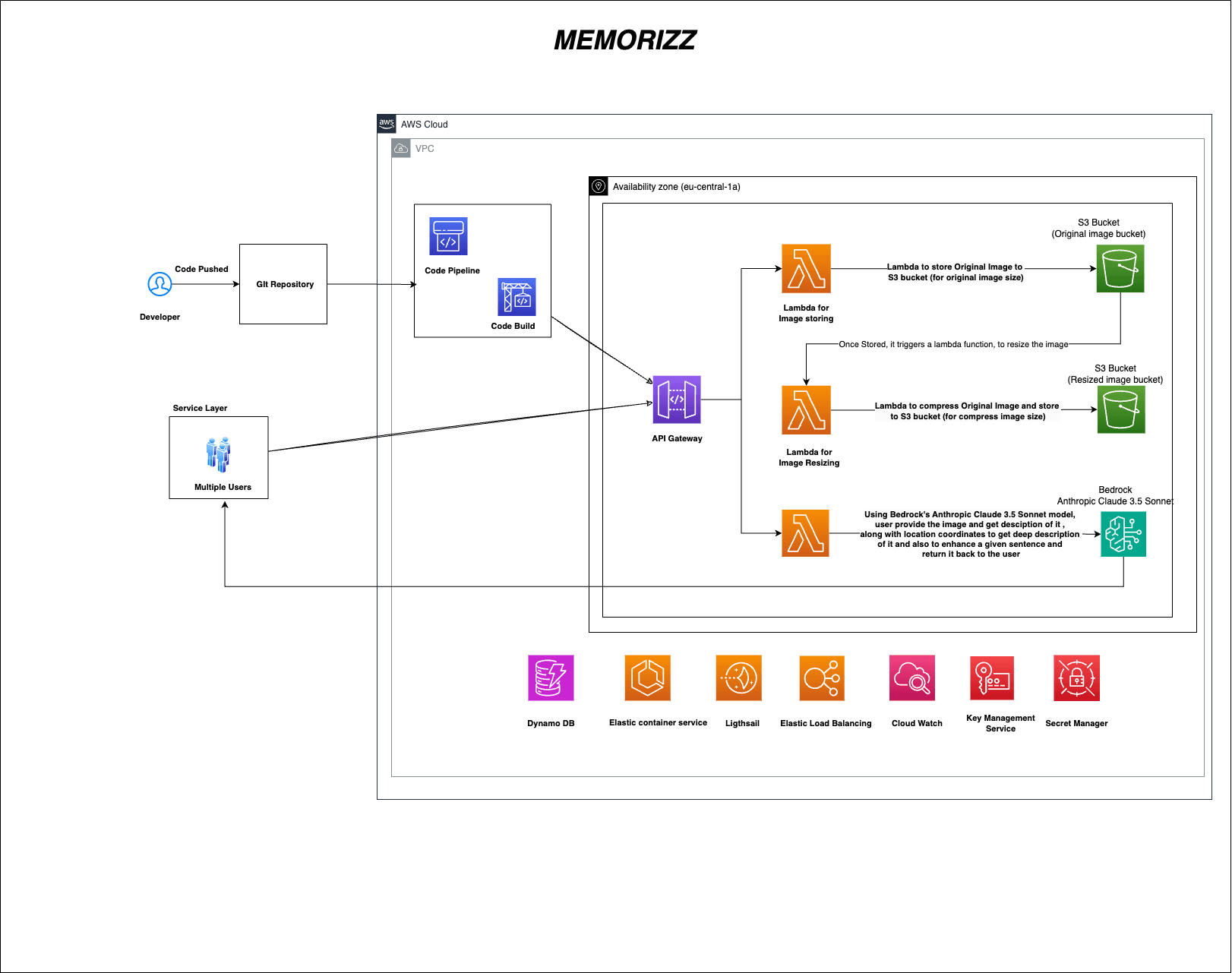
To address the challenges, AWS Elastic Container Service (ECS) was introduced as the central solution for hosting and managing containerized applications. The key components of the proposed solution were:
Containerized Application Deployment:
- Dockerized the application and used AWS ECS with Fargate for running the containers.
- Deployed backend services, including the API layer and processing components, as independent containerized microservices.
- Automated scaling of ECS tasks based on user demand.
Scalable Architecture:
- Integrated ECS with an Application Load Balancer (ALB) to distribute traffic efficiently across ECS tasks.
- Leveraged auto-scaling policies for ECS services to dynamically adjust compute resources during peak usage.
CI/CD Integration:
- Implemented a CI/CD pipeline using AWS CodePipeline and CodeBuild to automate the deployment of new features and updates to ECS services.
Security Enhancements:
- Used AWS Secrets Manager to securely manage environment variables and API keys for ECS tasks.
- Deployed services within a secure VPC, with strict security group rules.
Storage Optimization:
- Used S3 buckets to offload media storage and coupled them with ECS for seamless data integration.
Monitoring and Logging:
- Enabled Amazon CloudWatch for monitoring ECS task performance, logs, and errors.
Performance Optimization:
- Optimized backend processes like media resizing and AI caption generation by running them as separate ECS tasks.
Implementation Process
Application Containerization:
- Dockerized the entire application, including separate services for media processing, AI caption generation, and event management.
ECS Cluster Setup:
- Created an ECS cluster with multiple services for handling different application components.
- Configured tasks and services to leverage AWS Fargate for serverless container management.
CI/CD Workflow:
- Built an end-to-end deployment pipeline to integrate ECS with the Git repository for automated builds and deployments.
Scalability and Monitoring:
- Configured auto-scaling policies for ECS tasks and integrated CloudWatch alarms for proactive monitoring.
Security Integration:
- Integrated IAM roles and AWS Secrets Manager for secure access to credentials and sensitive data.
Impact of the Solution
Enhanced Scalability:
- The ECS-based architecture ensured that the application could scale dynamically, handling peak traffic effortlessly.
- Average response times improved by 40% during high-demand periods.
Cost Optimization:
- By using AWS Fargate for serverless container management, the customer saved approximately 30% in operational costs by eliminating the need for managing and provisioning infrastructure manually.
Improved Deployment Efficiency:
- The CI/CD pipeline reduced the deployment time from hours to minutes, significantly accelerating feature rollouts and reducing downtime.
Higher User Satisfaction:
- Faster media uploads, image resizing, and AI-driven captions increased user engagement and satisfaction.
- User retention improved by 25% within the first three months of migration to ECS.
Robust Security:
- The integration of Secrets Manager and secure VPC settings addressed key security concerns, ensuring user data protection.
Global Availability:
- The load balancer and ECS ensured low-latency access for users globally, improving the application's reach and performance.
Return on Investment (ROI)
The solution delivered significant ROI for the customer:
Cost Savings:
- Reduced infrastructure and operational costs by 30%.
- Automated scaling eliminated overprovisioning, leading to better cost efficiency.
Revenue Growth:
- Enhanced user experience contributed to a 20% increase in subscriptions within the first six months.
- Faster deployments allowed the customer to introduce monetizable features quicker.
Operational Efficiency:
- Automation in deployment and scaling reduced human intervention, freeing up resources for innovation and customer engagement.
Conclusion
The adoption of AWS ECS as the backbone of the Memorizz architecture resolved key scalability, performance, and security challenges for the customer. The solution not only enhanced the application’s performance but also optimized costs and operational efficiency, providing a sustainable and scalable foundation for future growth. The customer experienced a tangible improvement in ROI and user satisfaction, making ECS a critical component of their success story.


