





Aadhaar Masking Solution
AI-Powered Enhanced Personal Data Protection

Schedule a Demo
Over 250 Million Files Masked Without a Miss - That’s Real-World Reliability!


API-Based Solution
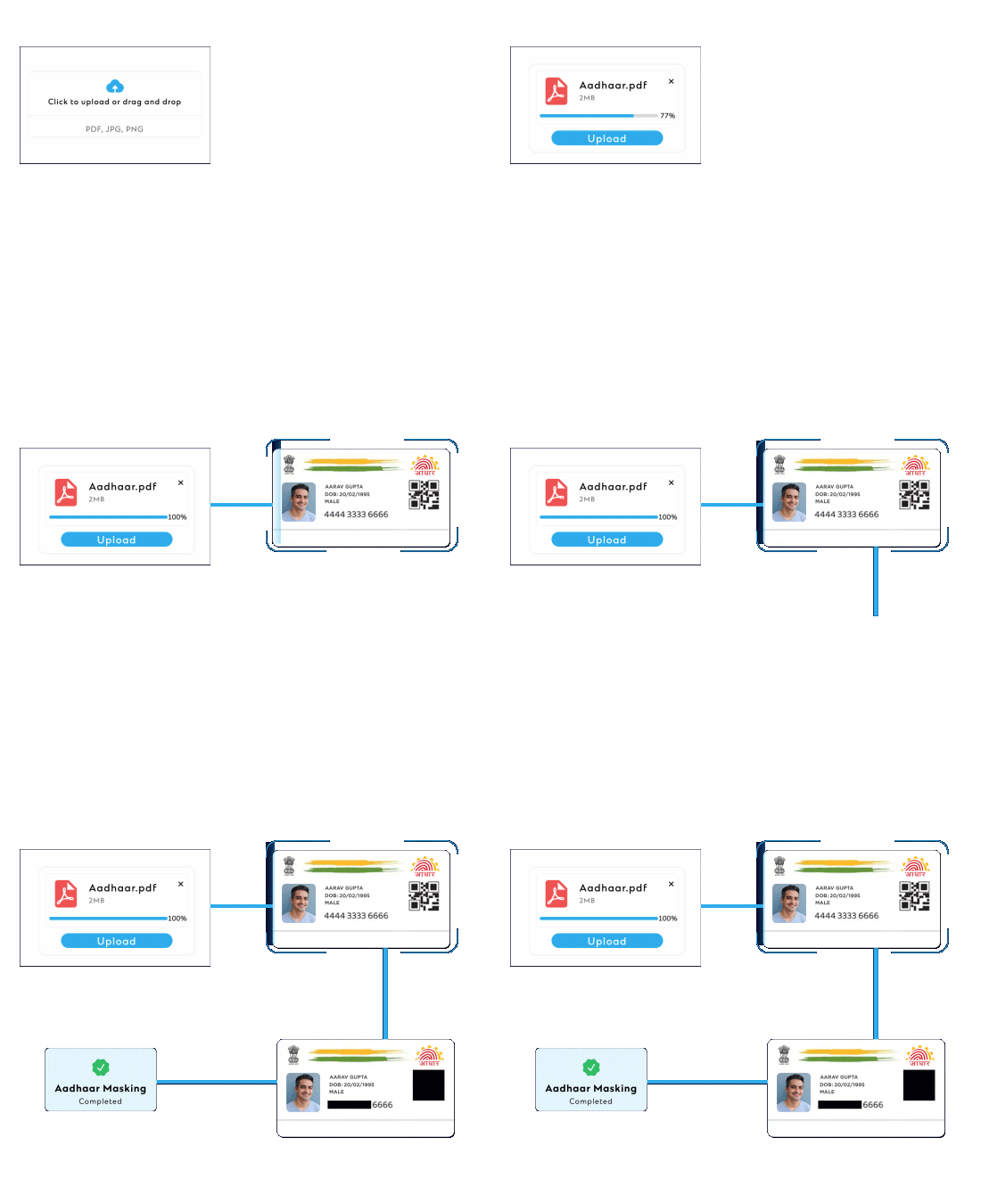
Ideal for real-time Aadhaar masking, our easily integrable API scans & masks Aadhaar details instantly within your applications. Best suited for businesses needing on-demand masking with seamless integration.

Bulk Masking Solution
Designed for large-scale document processing and legacy data transformation, our batch processing script automatically scans and masks Aadhaar details across thousands of files. This is perfect for organizations
Frequently Asked Questions
What is masked Aadhaar?
As per UIDAI, a masked Aadhaar hides the first 8 digits of an Aadhaar number and displays only the last 4. This helps organizations store Aadhaar details while protecting the privacy of the Aadhaar holders.
Is masked Aadhaar valid?
A masked Aadhaar is valid at places where there is no compulsion of sharing Aadhaar number. For eg, you cannot use it for bank account opening. While, in case of unauthorised or suspicious portals/agencies UIDAI suggests usage of masked Aadhaar.
Does Aadhaar masking apply to all businesses?
Yes, aadhaar masking regulations applies to all businesses in India, regardless of their size or age. If you are collecting aadhaar copies as proofs from your customers/employees/vendors, etc. then you must mask aadhaar before storing them in your database.
When do I have to mask Aadhaar numbers?
As per regulations, you will have to mask Aadhaar preferably at the point of capture and certainly before storing them permanently in your downstream systems and databases.
Can I store unmasked Aadhaar number in my database?
No. You as per regulations you cannot store the full Aadhaar Number in your downstream systems and databases. However, if you are a regulated entity and have an Aadhaar Vault system, you may store the full Aadhaar Number in your vault and then use a surrogate number in your downstream numbers.
In what ways can you mask Aadhaar images?
We can help you mask aadhaar in three simple ways: We help you mask Aadhaar images you capture from customers using our mobile SDK integrated into your own App (Android and iOS). We help you mask Aadhaar when users upload Aadhaar images as proof of ID on your web or mobile applications using our APIs and we help you mask all your historical Aadhaar images through batch jobs as a one-time step in your own servers.
How much does Aadhaar Masking cost?
Our advanced aadhaar masking solution boasts high accuracy and speed at a competitive price. With our API, easily integrate into your existing infrastructure for seamless implementation. Upgrade to our top-of-the-line solution today.
What does the UIDAI regulation dated 23 October 2018 say about Aadhaar Masking?
The UIDAI regulation issued on 23 October 2018 under Ordinance F.No.13012/171/2018/Legal/UIDAI/114 mandates Aadhaar Masking to protect individuals' privacy. As per this regulation, only the last four digits of the Aadhaar number should be visible, and the first eight digits must be masked when storing or sharing Aadhaar copies. This helps ensure compliance with data protection laws and prevents unauthorized access to sensitive personal information.
What does the RBI regulation say about Aadhaar Masking in KYC compliance?
The Reserve Bank of India (RBI) mandates Aadhaar Masking as part of its Master Direction on Know Your Customer (KYC), originally issued in 2016 and updated on May 29, 2019. Under this direction (RBI/DBR/2015-16/18 & DBR.AML.BC.No.81/14.01.001/2015-16), and its amendment (RBI/2018-19/190, DBR.AML.BC.No.39/14.01.001/2018-19), entities are required to mask Aadhaar numbers in customer documents to protect sensitive personal data and comply with data privacy laws. Only the last 4 digits of the Aadhaar number should be visible, ensuring secure KYC processing.
Is Aadhaar an acceptable KYC document under IRDAI regulations?
Yes, as per the IRDAI regulation dated 29 January 2019 (Ref: IRDAI/SDD/Cl R/MISC/020/01/2019), Aadhaar Card is allowed as one of the acceptable documents for KYC, provided certain conditions are met. This includes the implementation of Aadhaar masking to protect sensitive personal information and ensure compliance with data privacy standards.