





From Generative to Agentic AI: The Next Big Leap in Artificial Intelligence
ByHimanshu Vyas

Table of contents
Artificial Intelligence has evolved rapidly over the last decade. From simple rule-based chatbots to advanced large language models (LLMs) like ChatGPT, Gemini, and Claude, AI has transformed how people work, learn, and build technology.
But the next big shift has already started - Agentic AI.
While most of today’s AI systems still fall under the category of Traditional AI or Generative AI, emerging Agentic AI systems go a step further. They don’t just generate content — they can decide, plan, take actions, use tools, and even collaborate with other agents to complete tasks autonomously.
If you’re confused between these terms, you’re not alone. This blog explains the differences clearly, with examples, simple comparisons, and real-world use cases.
1. What Is Traditional AI?
Traditional AI refers to earlier forms of artificial intelligence that rely on:
- Rule-based systems
- Pre-programmed logic
- Statistical models
- Classic machine learning algorithms (like regression, decision trees, SVMs)
These models perform narrow and specific tasks. They cannot think, reason, or generate content creatively. Their main strength is pattern recognition.
Examples of Traditional AI
- Spam detection
- Credit card fraud prediction
- Google Maps route optimization
- Facial recognition
- Product recommendation engines
Traditional AI is powerful but not flexible - it works only within predefined boundaries.
2. What Is Generative AI?
Generative AI refers to systems that use advanced neural networks, especially large language models (LLMs), to create new content.
They can generate:
- Text
- Images
- Code
- Music
- Audio
- Video
Generative AI models like GPT-4/5, Midjourney, DALL·E, and Claude analyze massive amounts of data and produce original outputs that mimic human creativity.
Examples of Generative AI
- Writing emails, blogs, articles
- Generating images from prompts
- Writing code and debugging
- Creating marketing copy
- Summarizing long documents
- Translating languages
Generative AI can create, but it does not inherently act, plan, or take responsibility for tasks unless directly prompted each time.
3. Introducing Agentic AI - The Next Evolution
Agentic AI is AI that behaves like an autonomous agent. It doesn’t wait for instructions for every step - instead, it can:
- Set goals based on user instructions
- Break tasks into steps
- Make decisions
- Use tools and software apps
- Learn from outcomes
- Take actions in the real or digital world
- Collaborate with other agents
In short, Agentic AI moves from being assistive to becoming autonomous.
Examples of Agentic AI
An AI that manages your entire travel planning: searching for flights, comparing prices, booking tickets, scheduling reminders.
- A business agent that reads your emails, prioritizes tasks, replies automatically, and schedules meetings.
- A coding agent that builds an entire website, runs it locally, fixes bugs, and deploys it to production.
- AI agents running as “employees” inside companies — doing research, generating reports, or performing operational tasks.
- Agentic AI is goal-driven, not prompt-driven.
4. Key Differences Between Agentic AI and Generative/Traditional AI
Let’s break down the differences clearly:
A. Goal Orientation

Example:
- Generative AI: “Write an itinerary for a Singapore trip.” → You get one itinerary.
- Agentic AI: “Plan and book a 4-day Singapore trip for under ₹60,000.” → It searches hotels, compares dates, finds cheapest flights, builds itinerary, gives documentation, and may even book if permissions are given.
B. Autonomy
Generative AI cannot act unless you tell it exactly what to do. Agentic AI can act independently.
Example:
- Generative AI: “Write me a blog outline.”
- Agentic AI: “Research top 10 trends in AI, create a blog outline, prepare drafts, and publish it on my WordPress.”
It completes all steps automatically.
C. Multi-Step Reasoning
Generative AI typically handles one prompt = one response. Agentic AI handles complex tasks involving multiple steps and decisions.
Example — You want to create an e-commerce competitor report:
- Generative AI: Create a summary based on the data you provide.
- Agentic AI:
- Collect competitor information from websites
- Analyze pricing, product catalog, customer reviews
- Create charts, comparisons, and insights
- Generate PDF reports
- Email it to your team
D. Ability to Use Tools
This is the biggest difference. Agentic AI can use:
- Web browsers
- APIs
- Databases
- Email clients
- Excel/Sheets
- Calendars
- Operating system commands
- Code execution environments
Generative AI cannot use external tools unless manually scripted.
Example: An AI agent can log into your Google Ads account, analyze campaigns, optimize keywords, and download reports.
This is impossible for traditional generative AI.
E. Learning from Feedback
Generative AI resets after every prompt. Agentic AI can have memory, learn from mistakes, and update its strategy.
Example: If an agent tries to book a flight and the site fails, it will try alternate platforms.
5. Real-World Use Cases: Agentic AI vs Generative AI
1. Personal Productivity

2. Software Development

3. Business Operations

4. Customer Support

6. Example Scenario: Travel Planning
Using Generative AI
You: “Plan a 3-day trip to Goa.” AI: Gives a text itinerary.
End of the task.
Using Agentic AI
You: “Plan a 3-day Goa trip for under ₹12,000 and book everything.”
Agentic AI:
- Searches best prices across travel websites
- Checks your available dates in Google Calendar
- Books travel and hotels
- Generates confirmations
- Creates a packing list
- Sets reminders
- Tracks travel status
This is the leap from assistant to autonomous agent.
7. Why Agentic AI Matters
A. Reduces Human Effort
Instead of constantly prompting AI, you simply declare a goal. The AI does the heavy lifting.
B. Saves Time
It eliminates repetitive tasks like:
- Searching
- Copy-pasting
- Data entry
- Manual reporting
- Scheduling
C. Helps Non-Technical Users Achieve Complex Tasks
You don’t need to know coding, design, or analytics. Agentic AI handles everything.
D. Boosts Personal and Business Productivity
Agentic AI can act as:
- A virtual assistant
- A researcher
- A project manager
- A software engineer
- A finance analyst
One person can achieve the output of a small team.
8. Challenges and Limitations of Agentic AI
Even with huge potential, Agentic AI has challenges:
A. Reliability
AI may take wrong actions if not monitored.
B. Safety and Security
Agents accessing emails, bank portals, or private data need strict control.
C. Cost of Running Agents
Agentic systems may require more compute resources.
D. Decision Transparency
Understanding why an agent took a certain action is critical.
E. Over-Autonomy Risk
Agents must not perform unauthorized actions.
9. Future of AI: Autonomous Ecosystems
The future will have AI ecosystems, not just apps.
Imagine:
- A financial agent that manages investments
- A health agent that monitors your workouts, meals, and sleep
- A home agent that controls appliances and security
- A work agent that manages your projects
- A learning agent that teaches you new skills
These agents will talk to each other, creating a personal AI operating system.
This is the direction in which companies like OpenAI, Google, Meta, and Microsoft are moving.
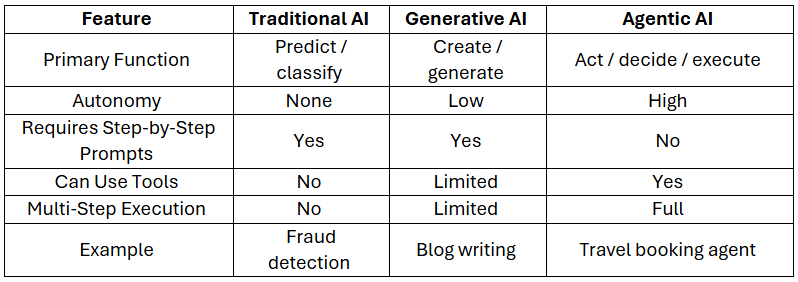
10. Summary: Key Differences Table
11. Final Thoughts
Agentic AI is not just an upgrade - it is a fundamental shift in how AI interacts with the world. While Traditional AI made machines smart and Generative AI made machines creative, Agentic AI makes machines capable of action.
We are stepping into an era where AI doesn’t just give answers; it gets things done.
For businesses, creators, developers, and everyday users, Agentic AI offers groundbreaking possibilities - from automation to innovation.
The future belongs to AI systems that don’t just assist but act as collaborators.