





The ROI of Generative AI: Why Every Business Needs to Invest Now
ByAnjali Jain

Table of contents
Every business leader is talking about generative AI, but beyond the hype, one question remains unanswered: Does it really pay off?
The answer from early adopters and researchers is a resounding “Yes”. Generative AI tools deliver tangible returns on investment (ROI) through:
- Boosted AI-powered productivity
- AI-driven cost savings
- New revenue streams.
In fact, a recent global survey found 74% of enterprises using generative AI are already seeing positive ROI, with another ~30% expecting returns within a year.
For small businesses (SMBs) and startups, these technologies can level the playing field, allowing them to compete with larger firms by working smarter.
Let’s explore how GenAI is driving ROI and why investing now is crucial to avoid being left behind.
How Generative AI Translates to Real Business Value
ROI is about getting more value out than you put in. GenAI makes this possible by automating creative and knowledge-intensive tasks that were previously time-consuming or expensive. Unlike traditional software, GenAI can produce original content with minimal human input. This uncovers new efficiencies and capabilities for businesses of all sizes.
A McKinsey analysis even estimates that current generative AI technology could automate work activities that occupy 60–70% of employees’ time today.
The best part? These generative AI tools cost just $20-100 per month but can do work that would normally cost thousands in employee time or contractor fees.
The math becomes very attractive: if an AI tool costing $100/month saves an employee 10 hours of work, and that employee’s time is worth $50/hour, you’re effectively gaining $500 of value for a $100 expense. That’s a 5x return (400% ROI) in just one month.
Key Benefits Driving ROI from Generative AI
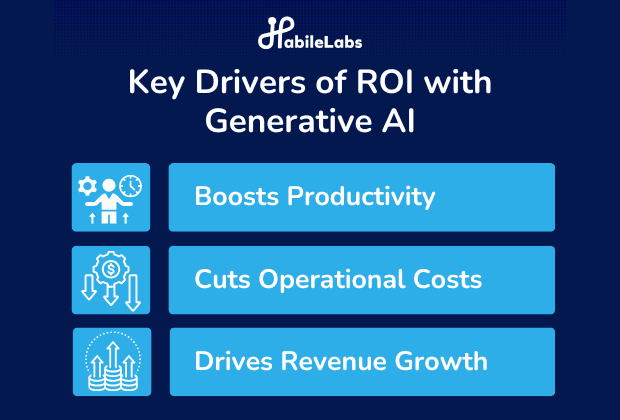 Businesses of all sizes are making significant investments in artificial intelligence because it provides actual benefits that increase ROI. Here are the most common benefits of using AI for business automation:
- Productivity Gains: Time Saved is Money Earned
GenAI significantly boosts productivity by handling routine or labor-intensive tasks, freeing human workers for higher-value activities. Tools like ChatGPT can draft emails, marketing copy, and reports quickly. Salesforce research shows the average generative AI user saves about 5 hours per week, equivalent to over 32 full workdays annually.
GitHub Copilot and other AI coding assistants can increase software development speed by 55%. For startups, this translates into quicker product launches and a competitive advantage. AI can also create spreadsheets, handle customer FAQs through chatbots, and produce data insights, which reduces the amount of manual labor and improves cost- efficiency per task. These improvements reflect strong gains in AI-powered productivity.
In addition to speed, AI ensures consistent quality by cutting down on mistakes and rework, which improves customer satisfaction, retention, and revenue.
- Operational Cost Reductions
Using generative AI technology to automate processes leads to immediate cost reductions. AI can be used to handle everyday duties, such as data input, report creation, and initial customer care, which lowers labor expenses and human error.
According to a BCG study on AI in procurement, companies using AI can reduce procurement costs by roughly 15%–45%, depending on the category. This shows that AI-driven cost savings are not limited to IT but extend to core operations as well.
- Enhanced Revenue & Conversion Growth
AI-powered product suggestions, customized advertising, and 24/7 chatbots improve consumer satisfaction and increase conversion rates. Companies that use AI to personalize their communications have seen increases in customer lifetime value and engagement.
According to a Forrester report, businesses that implemented GenAI products witnessed a 6% rise in net income in. This underscores how Generative AI ROI extends to top-line growth, not just savings.
Why Invest Now?
So, why the rush?
Because the competition isn’t waiting.
Over 75% of global enterprises are already using AI systems in at least one business function, which shows that the adoption of AI is reaching a turning point across industries. Falling behind, even for a few years, might cost you a lot of market share and operational efficiency.
Most of the companies' executives see GenAI as "now or never" opportunity. A recent survey found that almost all executives are optimistic of rapid returns and intend to increase the usage of AI technology.
“Upskilling on AI now is critical... In five years, running a business without GenAI tools would be like trying to run a company today using typewriters instead of computers.” — Forrester study interviewee on the importance of AI adoption.
And the ROI is hard to ignore:
A January 2025 IDC analysis shows businesses are achieving a remarkable 3.7× ROI. That means $3.70 returned for every $1 invested in generative AI.
Those eye-popping numbers illustrate how dramatically the right AI deployments can pay back their costs. While not every AI project will triple your investment, this example shows that waiting means foregoing possibly transformative gains.
Maximizing ROI: How to Approach Generative AI Implementation
Using generative AI isn't a remedy, your approach is key. Numerous AI projects have failed because of unclear objectives or inadequate implementation. Think about putting these best practices to maximize your AI adoption ROI:
-
Start with High-Impact, Feasible Projects: Identify pain points or tedious processes in your business where AI can make an immediate difference. These are often repetitive, time-intensive, and rule-based, like drafting standard customer emails or generating regular reports. By starting with a well-defined use case, you can more easily measure the before-and-after impact.
-
Define Clear ROI Metrics: Prior to implementing AI systems, determine how you will assess its effectiveness. Establish clear Key Performance Indicators (KPIs) linked to ROI, such as weekly hours saved, decreased error rates, higher monthly revenues, or higher customer satisfaction ratings.
-
Invest in Training and Change Management: Provide time forProvide staff training on the latest AI technologies and buildbuilding an innovative culture. Workers might have to learn how to understand insights from an AI analytics platform or how to create prompts for AI writing assistance. Always remember that the best return on investment is achieved through human + AI partnership.
-
Scale Up Carefully: Consider early AI initiatives to be pilots. Iterate and grow after starting small and assessing the results. You can start by automating a single department or process. Then extend AI deployment to different tasks once it's functioning properly and producing results. By implementing a staged strategy, you can avoid wasting money on strategies that don't benefit your company.
By following these steps, businesses can avoid common challenges and maximize the value gained from their AI investments. The era of aimless experimentation is over, now it’s about smart experimentation with an eye on measurable outcomes.
How to Calculate ROI of Generative AI
Understanding whether AI investments truly pay off starts with asking the right questions and tracking the right metrics. While measuring ROI is essential, it’s also not always straightforward, because AI for business can impact multiple areas at once like productivity, innovation, and cost efficiency.
Ask the Right Questions -
- Which specific tasks can we automate with generative AI?
- How much time and cost would that save?
- What quantitative metrics like hours saved, error reduction, and additional revenue will indicate success?
- What benchmarks from similar industries or projects can we use?
These questions ensure your ROI framework is rooted in real business outcomes.
Need a Fast AI ROI Check?
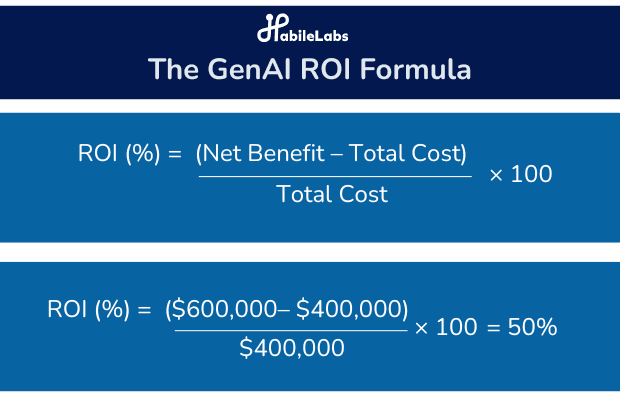
Use this simple formula to quickly calculate your return on investment:
Define a Clear ROI Formula -
For example:
Use Multiple Metrics, Not Just Monetary
AI delivers more than just cost savings:
- Efficiency gains – How many hours are saved?
- Employee productivity – What higher‑value tasks are enabled?
- Innovation output – Are new ideas, products, or services emerging from AI use? A holistic view helps you assess both tangible and intangible returns.
Conclusion
The message is clear: GenAI is producing a quantifiable return on investment.
It's a strategic asset that improves productivity, encourages creativity, and drives overall progress. This gives SMBs the ability to grow, customize, and innovate in unthinkable ways.
Similar to industrial revolutions, early AI adopters will see a growing competitive advantage. This is the time to revamp your business and ensure a stronger bottom line.
If you're considering the leap into GenAI, HabileLabs can support you every step of the way, from strategy to implementation.
Embrace AI for business today - your future growth depends on it.